
SLEEP-RELATED BREATHING DISORDERS AND DUST MITE ALLERGIES
Chronic rhinitis and sleep disorders
Sleep disorders, including obstructive sleep apnea syndrome, are sometimes associated with allergy attacks. These allergies manifest as chronic rhinitis, which causes nasal congestion during the night. Even a simple blocked nose can disrupt sleep quality and worsen sleep-related breathing problems. A blocked nose promotes snoring and daytime fatigue, both indicators of poor sleep quality.
The Links Between Chronic Rhinitis and Sleep Quality
Allergies in general, and dust mite allergies in particular, have negative effects on sleep quality. The more severe the allergic rhinitis, the more sleep quality deteriorates. These phenomena are present in both adults and children . 60% of children with allergic rhinitis (which may be caused by dust mites) snore.
The links between allergic rhinitis and sleep apnea.
Obstructive sleep apnea affects between 5 and 15% of the adult population. Chronic rhinitis affects an average of 20 to 30% of the population. The likelihood of developing obstructive sleep apnea (OSA) increases by 44% in adults with allergic rhinitis.
Influence of bedding on dust mite allergy
Dust mites love humidity and warmth. Our bedding, and especially our mattresses, are the ideal habitat for dust mites. They find moisture, the heat emitted by our bodies, and food from our skin flakes.
How to protect yourself from dust mites in the bedroom
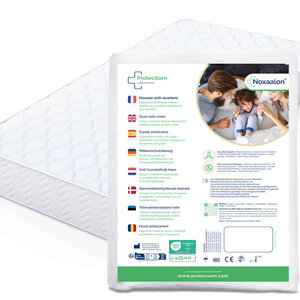
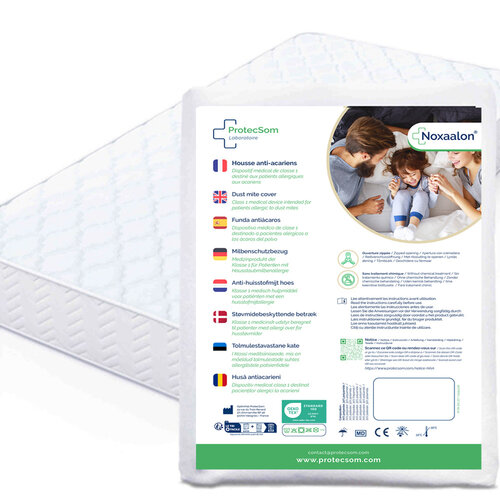
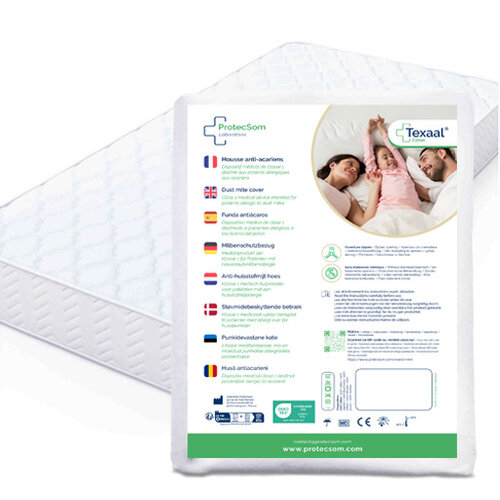
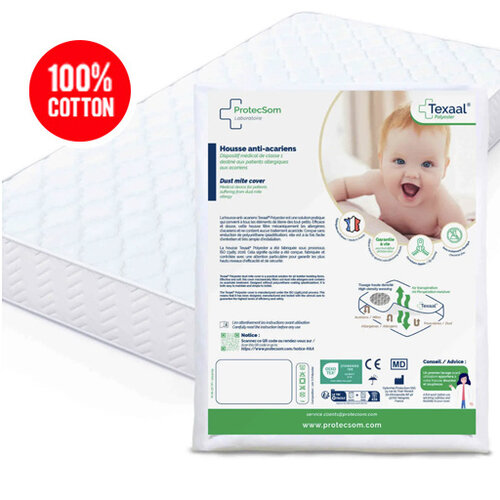
- Use an anti-mite fitted sheet that completely covers the mattress (thanks to the zipper).
- Choose a medical-grade fitted sheet "MDR"
- Air your mattress regularly and, if possible, in the sun.
- Wash your duvets and pillows three times a year, or use anti-mite duvet covers and pillowcases.
- DO NOT use anti-mite sprays. These can cause allergic reactions due to the presence of permethrin. We are primarily allergic to dust mite droppings.
- Do not heat the room above 19°C
Which textile is used to manufacture our fitted sheets ?
Evolon® is a technical non-woven textile made from ultra-fine microfibres (mainly polyester and polyamide). It is designed to provide a highly effective mechanical barrier without the use of chemical treatments.
Why is Evolon® used for anti-dust mite covers?
1. Physical barrier against dust mites and their allergens
-
Dust mites measure approximately 200 to 300 microns.
-
Their allergens (faecal particles) are even smaller.
-
The structure of Evolon® has pores smaller than 10 microns, which:
-
prevents dust mites from passing through,
-
effectively blocks allergens,
-
while still allowing air circulation.
-
- 2. Excellent breathability
Unlike coated or laminated fabrics:
-
Evolon® is air- and moisture-permeable,
-
it reduces night-time perspiration,
-
it avoids the “plastic” or “tarpaulin” effect often associated with low-end anti-mite covers.
This significantly improves sleep comfort, even on mattresses.
3. Softness and comfort-
Supple, textile-like feel, similar to a traditional fabric,
-
Silent (does not crinkle when moving),
-
Suitable for direct skin contact, even for sensitive skin.
-
Effectiveness achieved without biocides, acaricides or coatings,
-
Suitable for:
-
allergy sufferers,
-
children,
-
infants,
-
people with sensitive or eczema-prone skin.
-
-
Machine washable (often up to 60 °C),
-
Withstands repeated washing without loss of effectiveness,
-
Quick drying.
-